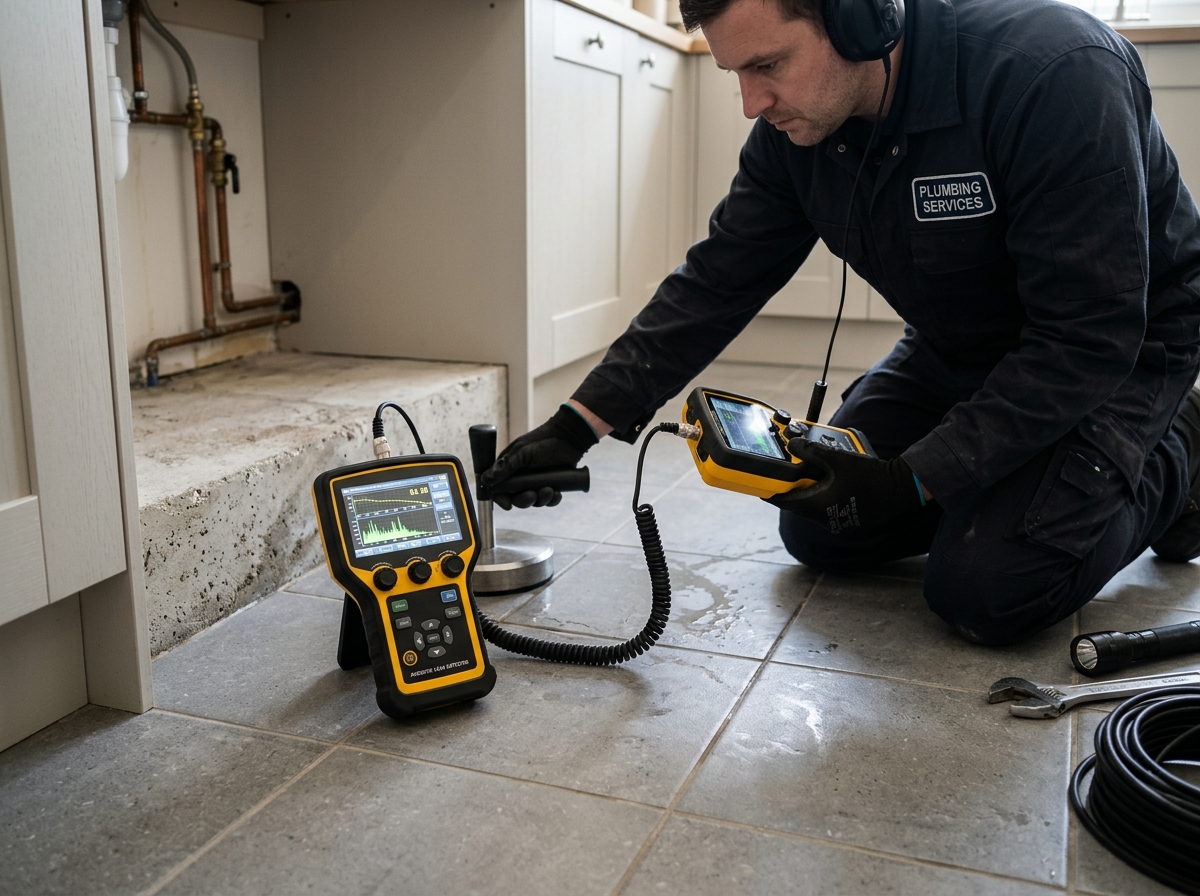
Precision Diagnostics for Victoria Slab Foundations
A water line leaking beneath a poured concrete slab can saturate sub-base soils for weeks before surface dampness or warm flooring becomes apparent. Guesswork has no place in foundation diagnostics. Breaking open concrete at random locations damages structural slabs, ruins decorative tile, and escalates repair costs.
Our comprehensive slab leak detection Victoria methodology isolates exact failure coordinates through non-destructive electronic testing. Whether your property is located near Downtown Victoria or neighboring ranch-style developments along Loop 463, our diagnostics protect your foundation and flooring while guiding targeted restoration.
Early Warning Signs Demanding a Slab Leak Test
Because pipes are buried beneath inches of concrete and gravel, recognizing early symptoms prevents costly foundation movement:
- Continuous Municipal Meter Spin: When all indoor faucets, ice makers, and hose bibs are shut tight, the sensitive flow triangle or digital readout on your city water meter continues to register movement.
- Audible Water Hissing: A subtle hissing or rushing sound resonating through floorboards or interior partition walls when the house is completely quiet.
- Localized Floor Warmth: A distinctive warm spot on porcelain tile, wood-look laminate, or carpet indicating that a hot water supply line is discharging underneath the slab.
- Unexpected Utility Spikes: Higher than normal monthly water consumption or sharp rises in gas or electric bills from continuous water heater operation.
- Damp Baseboards and Sheetrock: Moisture wicking up into wall framing, peeling paint, or loose threshold trim around hallways and bathrooms.
Suspect a Leak Under the Slab?
Get reliable, non-invasive electronic leak detection from experienced Victoria plumbing specialists.
(888) 205-7875Step-by-Step Electronic Leak Detection Process
Locating a leak under slab detection Victoria requires a sequential, rigorous process designed to systematically rule out above-ground fixtures before zeroing in on sub-slab pipes:
1. Static Meter and Isolation Testing
We begin by testing the municipal meter and performing an initial shutoff isolation. Technicians verify whether the leak is on the exterior main supply line or downstream within the home footprint. We check toilets, irrigation backflow preventers, and water softener loops to ensure fixtures are not leaking internally.
2. Hot vs. Cold Domestic Line Isolation
Next, the domestic cold water supply is separated from the water heater circuit. High-resolution pressure gauges are mounted to the system. By monitoring pressure drop rates on each isolated branch, we determine conclusively whether the pressurized leak is on the hot water distribution line or the cold water supply.
3. Electromagnetic Pipe Line Tracing
Sub-slab plumbing rarely follows straight visual lines. Technicians connect a low-frequency transmitter to copper pipe risers, inducing a traceable electromagnetic signal throughout the buried plumbing manifold. Using an electronic handheld receiver, we accurately map the exact route and depth of the pipes beneath the concrete floor.
4. Electronic Acoustic Listening & Ground Sonar
Water escaping under pressure creates a distinct high-frequency vibration as it shears through tiny fissures into surrounding sub-slab soil. Using specialized acoustic listening discs, ground microphones, and noise-filtering amplifiers, technicians traverse the mapped pipe line. By calibrating decibel frequencies across square-foot increments, we isolate the exact acoustic peak of the leak.
5. High-Resolution Thermal Imaging
When dealing with heated domestic lines, infrared thermography reveals subtle thermal patterns radiating upward through concrete, thin-set mortar, and tile. Thermal scans verify acoustic data, creating a multi-point confirmation of the leak location.
Why Accurate Location Keeps Concrete Breaking to a Minimum
In older Victoria properties, the expansive clay sub-soil makes concrete foundation stability delicate. Uncontrolled jackhammering creates micro-fractures in concrete grade beams and generates airborne silica dust throughout the living space. When electronic leak detection accurately pinpoints the leak within a few inches, homeowners have clear choices:
If direct spot repair is chosen, excavation is confined to a minimal, surgically cut concrete opening. Alternatively, if the homeowner elects a modern slab leak reroute, detection confirms which exact line requires bypassing without damaging any concrete whatsoever. To understand wider foundation impacts, explore our comprehensive guide to slab leak repair in Victoria.
What the Written Leak Report Includes
Following every diagnostic evaluation, we provide homeowners and property managers with an exhaustive, professional inspection report. This clear documentation is essential when filing insurance claims or comparing repair alternatives:
- Pressure Test Logs: Precise starting, ending, and decay pressure readings confirming system loss.
- Schematic Mapping: A diagram showing the layout of the subsurface pipe run and the identified breach location.
- Thermal and Acoustic Data: Infrared imagery captures and acoustic decibel readings documenting the point of failure.
- Substrate & Pipe Condition Assessment: Notes regarding pipe material, visible corrosion, and soil moisture observations.
- Actionable Repair Recommendations: Clear technical options comparing targeted repair versus overhead PEX reroutes or whole house repipe alternatives.
Schedule Your Slab Leak Test in Victoria Today
Protect your home foundation with professional electronic leak detection. Call now to speak with our diagnostic team.
(888) 205-7875